
WA's Electricity Demand Expected to Slow
The Australian Energy Market Operator (AEMO) has released its Deferred 2015 Electricity Statement of Opportunities for the 2017–18 Capacity Year report, revealing the benefits private solar PV systems have had on WA’s electricity demand.
The South West Interconnected System Electricity Network, more commonly known as SWIS, is managed by Western Power, and extends south from Kalbarri to Albany, and east from Perth to Kalgoorlie, incorporating over 7,800km in transmission lines. In a year, the SWIS network supplies over one million customers with 18 terawatt hours of electricity. (1 terawatt = one trillion watts).
WA's Electricity Demand Expected to Slow
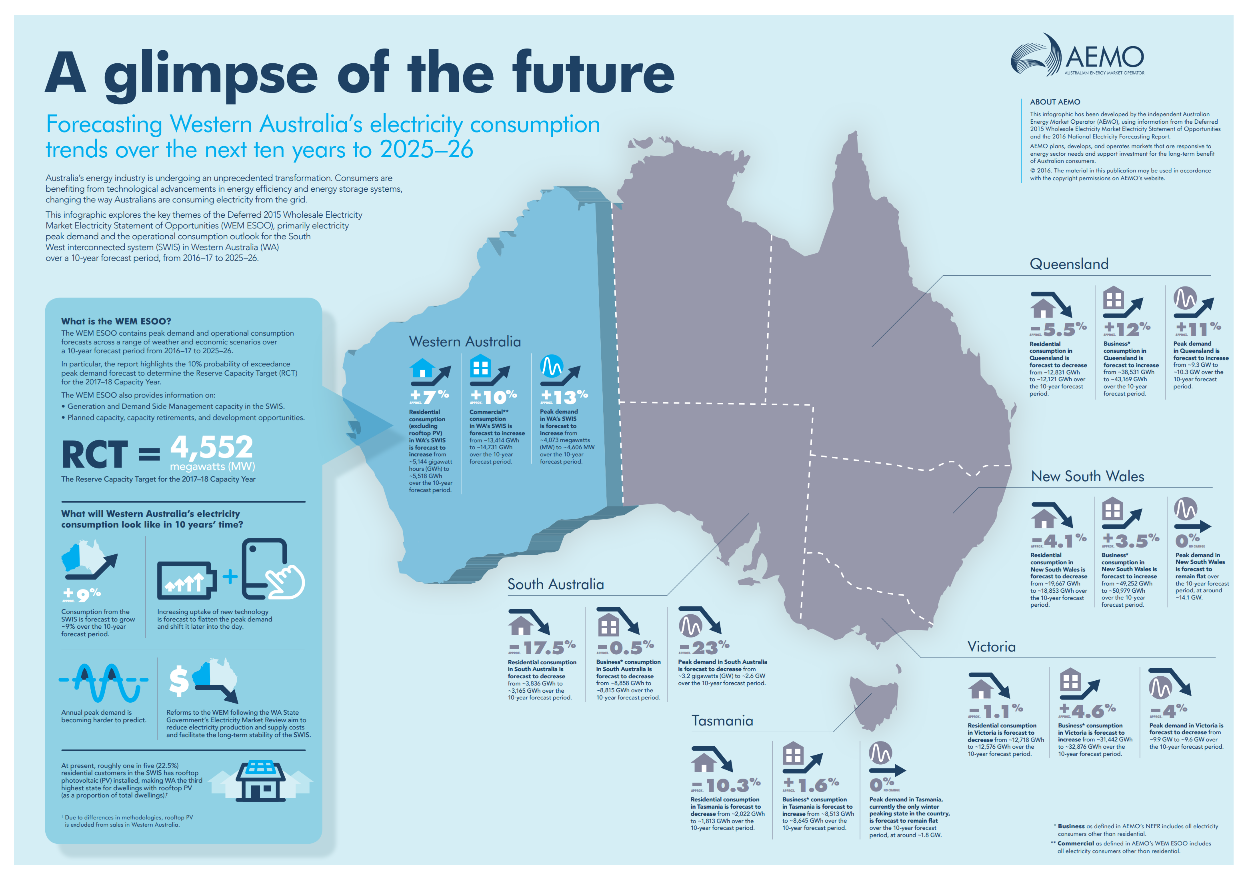
AEMO’s report showed that although customers may have a growing amount of electrical appliances at their disposal, WA's electricity demand from the SWIS is expected to slow down over the next ten years.
“We’ve determined the Reserve Capacity Target (RCT), that is the amount of generation capacity required in the SWIS to efficiently meet forecast demand over the next two years, to be 4,552 megawatts (MW),” said Mr Zema, AEMO Managing Director and Chief Executive Officer.
“Given the current level of installed and committed capacity in the SWIS, no new generation or demand side management capacity will be required over the forecast period.”
Rooftop PV has Played a Significant Role in the Slowdown
This slowdown is due to a number of factors, including consumers becoming more aware of their energy usage and making an effort to monitor it, energy efficient devices becoming cheaper and more prevalent in the market, and sustainable energy generation options such as rooftop solar systems becoming more popular.
“The report shows that forecast growth in rooftop solar PV, energy efficiency, battery storage, and in-home energy monitoring devices is expected to result in slow electricity consumption growth from the SWIS from around 18,452 GWh in 2015–16 to around 20,249 GWh by the end of the 10-year outlook,” said Mr Zema.
Rooftop solar PV systems are now being installed by one in five homeowners, and with technology like battery storage becoming more affordable, WA's electricity demand from the network is already reducing, with peak demand also shifting to later on in the day.
In the past, the annual peak demand in the SWIS has occurred on a day in February, late in the afternoon. Due to the changes in consumer behaviour mentioned above, three of the last five annual peaks have occurred earlier in the year, and later in the day.
“Rooftop PV is estimated to have reduced peak demand on 8 February 2016 by around 96 MW, or 2.3%, from 4,109 MW to 4,013 MW. AEMO estimates that rooftop PV also shifted peak demand by an hour, from the 16:30 to 17:30 trading interval,” said Mr Zema.
Rooftop PV Installations Will Continue to Increase
Due to technological improvements, rising electricity tariffs, and falling solar costs, AEMO expects the rooftop PV capacity in the SWIS to continue to grow, “We expect rooftop PV capacity in the SWIS to continue to grow off the back of technological, commercial and regulatory factors such as government incentives, falling installation costs, electricity tariffs, and changes in consumer attitudes and behaviours.”
This uptake of solar and battery technologies will benefit all grid users:
- Less peak demand will encourage longer life of SWIS infrastructure, lowering network costs.
- Localised generation sources means electricity needs to travel much shorter distances, lowering transmission costs.
- Later peak demand will decrease bills for those on time of use tariffs.
- Slowdown of demand means no new generation sources are needed, saving in generation costs.
In the future, when electricity retail contestability becomes a reality for homeowners, these savings will be passed on by providers like Infinite Energy.
For a full copy of the AEMO’s report, click here.